
Havant and CAI: revolutionizing document management with AI-Docs
With more than 200,000 customers served and 300 branches nationwide, CAI (Consorzi Agrari d’Italia) is a leading player in the agricultural support sector and aims to become a national leader in the digitization of the agribusiness industry as well.
A significant step forward in this direction comes thanks to the partnership with Havant and the adoption of the AI-Docs platform, which integrates the latest artificial intelligence technologies to automate and manage the entire document repository in an advanced manner.
A digital transformation project born out of real needs
The ambitious document digitization project launched by Consorzi Agrari d’Italia (CAI)—a leader in modernization efforts supporting Italian farms—began in 2023 with a clear objective: to completely transform the management of paper-based documentation across its agencies. In fact, every day, the agencies and branches produce a variety of documents, invoices, delivery notes, contracts, and much more, highlighting the need to go beyond the limitations of simple digital archiving. CAI’s need was clear: not only to create a digital archive, but to obtain structured and easily accessible information capable of optimizing and automating the entire cycle of document collection, sorting, classification, and storage, thereby improving operational efficiency, reducing costs, and enhancing the value of its document assets.
To meet this challenge, CAI chose Havant—the successor to SB Italia—as its strategic partner for the digitization and document management of its branches, initially relying on OCR (Optical Character Recognition) technology to detect and read the barcodes present in the documents.
“The project kicked off last year,” says Pablo Pellegrini, Intelligent Process & Content Automation BU Director at Havant, “with the goal of converting our paper-based document archive into digital format. The real challenge was to build a scalable, advanced infrastructure capable of automating the reading of barcodes in the PDF files that branches send us every day, thereby integrating efficiency and accuracy into the document management process.”
Initial requirements and key operational challenges: the added value of the AI-Docs platform
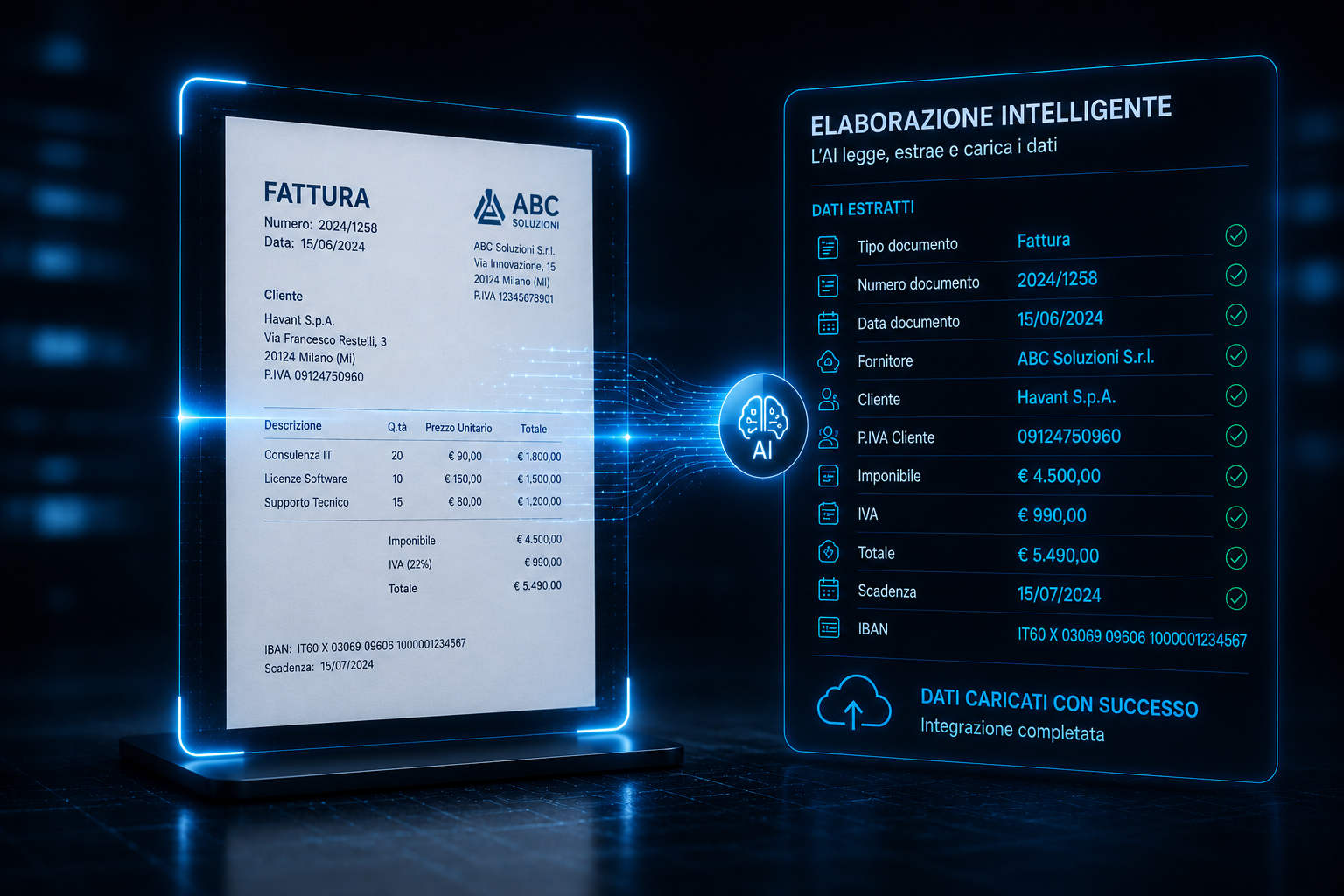
The document digitization project launched by CAI was driven by very specific needs: not only to digitize processes, but to do so with the highest possible level of accuracy and automation, minimizing the need for manual intervention. To this end, the AI-Docs platform represents the true technological heart of the initiative. Thanks to its advanced capabilities, the platform enables not only automatic data extraction via OCR and barcode reader technologies, but also document classification, workflow management, and the generation of customized outputs, automatically assigning essential metadata to ensure compliant digital preservation.
One of the main obstacles encountered along the way was the often suboptimal quality of the barcodes: “Barcode readers work best only with perfect images,” emphasizes Luca Rodolfi, Data & AI BU Director at Havant. “In reality, however, we find ourselves dealing daily with documents featuring crumpled pages, uncalibrated scanners, and labels that are incorrectly applied or deteriorated. Under these conditions, automatic code reading failed more often, requiring manual intervention to resolve the anomalies.”
To address this very challenge, an innovative artificial intelligence module—based on advanced machine learning algorithms—was developed and integrated. This module is capable of directly reading text and recognizing codes even in the absence of a valid barcode, thereby ensuring full comprehension and accurate archiving of documents even when anomalies arise due to printing or scanning errors.
OCR technology, which has achieved approximately 90% accuracy in barcode-based classification, was only the first step on an even more ambitious journey. “Our stated goal was 99% accuracy,” says Ugo Mattia, Head of IT Infrastructure at CAI, “because only then could we guarantee truly efficient processes at scale and meet the growing demands of the market. And by large scale, we truly mean a significant volume of material: considering the agencies currently involved in the project, located across 45 provinces, the number of documents scanned daily reaches into the thousands. These documents vary widely in nature: from supplier invoices to records pertaining to individual agencies. Thanks to the partnership with Havant, this important activity has been automated, and staff have been relieved of a delicate and very time-consuming task. The goal for this year is to extend the partnership to all of the more than 300 agencies currently operating in Italy, thereby continuing CAI’s digitization journey,” concludes Ugo Mattia.
Technology and Process: Integrating AI-Docs to Overcome the Limitations of OCR
“AI comes into play when the traditional system classifies a document as anomalous,” explains Luca Rodolfi. “It doesn’t attempt to read the damaged bars, but instead uses OCR to read the underlying text and applies intelligent rules to recognize valid codes, thereby still returning the correct information and maintaining the process’s high reliability.”
The integration of the AI-Docs platform is therefore a strategic step toward overcoming the limitations of traditional OCR technologies and ensuring that CAI has a truly efficient, reliable, and scalable document management system for the future.
The results of the AI-Docs implementation at CAI
The new system has led to a drastic reduction in problematic documents, eliminating the need for manual intervention and overcoming issues related to damaged barcodes, thanks to more robust and reliable text recognition. The classification and sorting of documents intended for digital preservation are now fully automated through the assignment of structured metadata, thus enabling the centralized management of increasingly large volumes of documents from a network set to expand nationwide.
Concrete and measurable benefits include high and consistent process accuracy over time, the elimination of errors in management and preservation, reduced processing times, and easy access to documents, thanks to automatic and intelligent distribution. Furthermore, the system stands out for its full scalability, making it ready to support future business expansion.